Most complaints about capos are complaints about how they are being used. Three things fix nearly all of them.
1. Directly behind the fret
Place the capo bar as close as possible to the fret you are capoing at, on the headstock side of it — not on top of the fret, and not halfway between two frets.
The reason is exactly why you put your finger there. The fret does the work of stopping the string; the capo only needs enough pressure to hold the string against it. Sitting further back means the string has to travel further to reach the fret, which needs more pressure and stretches the string more, which pushes the note sharp.
Too far forward — on top of the fret — mutes and buzzes.
2. The least pressure that works
Every bit of pressure beyond what is needed to stop the string cleanly is pressure stretching the string sharp.
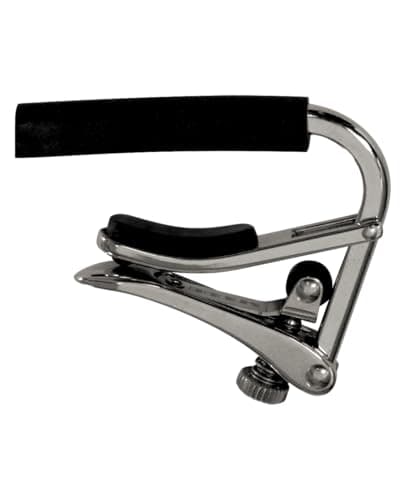
With an adjustable capo (Shubb), set the tension screw so the lever closes firmly but not violently and no string buzzes. Set it once for your guitar. That single adjustment is why this design disturbs tuning less.
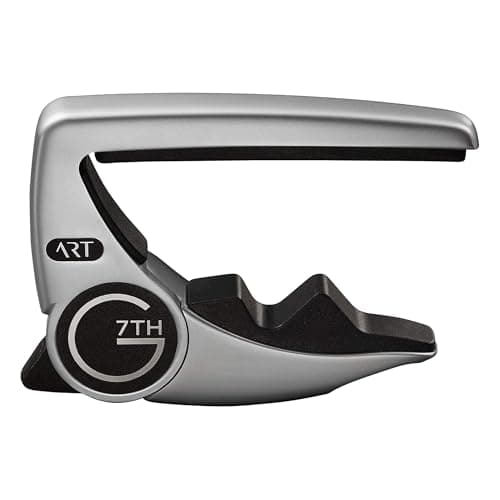
With a squeeze capo (G7th Performance 3), you set the pressure by hand each time. G7th's stated aim is maximum tuning stability at the minimum tension required, and the mechanism is built to let you find that.
With a fixed-tension spring capo (Kyser, Dunlop Trigger), you cannot adjust it. If your guitar goes sharp under it, that is the design meeting your neck, and the fix is a different capo rather than a different technique.
Behind the fret
Where the capo goes, every time
Not on the fret, not between frets. The same place your finger goes, and for the same reason.
3. Check the tuning, with the capo on
Fit the capo, then tune. Not the other way round.
Tuning without the capo and then fitting it means tuning to a state you are about to change. Any capo will shift the pitch slightly; how much depends on the capo, the neck and your string gauge. Tune with it in place, at the fret you are using, and the guitar is in tune for the thing you are about to play.
If you move the capo to a different fret mid-session, check again. The amount of sharpening varies by position — it is usually worse higher up the neck, where the frets are closer together and the placement tolerance is tighter.
Common problems
Symptom to cause| Symptom | Usual cause | Fix |
|---|
| Everything sounds slightly sharp | Too much pressure, or capo too far behind the fret | Move it closer to the fret; reduce pressure if adjustable |
| Buzzing on the outer strings | Bar curvature does not match the fretboard radius | A radius-adapting capo, or reposition slightly |
| Buzzing on one string | Capo sitting on top of the fret, or a worn pad | Move behind the fret; check the pad |
| Muted notes | Capo too far forward, over the fret | Move it back behind the fret |
| Capo slips while playing | Weak spring, or a neck thicker than the capo suits | A different capo; adjustable ones handle thick necks better |
| Marks on the neck finish | Prolonged contact with the pad, common on nitro | Take the capo off when you put the guitar away |
Where to park it
Kyser-style spring capos clamp onto the headstock behind the nut between songs, which is convenient and keeps it findable. G7th describes parking the Performance 3 on the headstock or just behind the nut too.
A Shubb does not park; it goes in the case pocket. That is a small practical cost against its tuning advantage.
One caution for any capo left clamped for long periods: prolonged contact between rubber pads and a nitrocellulose finish can mark it. Take the capo off when the guitar goes away.
Reading capo instructions in songs
"Capo 2" means put the capo at the second fret and play the chord shapes as written. The shapes are the shapes you know; the sounding key is two semitones higher.
So a G shape with a capo at fret 2 sounds an A. If you are playing with someone who is not using a capo, they need the sounding names, not the shape names — that mismatch is the commonest source of confusion in a room with two guitarists.
What we did not doWe have not played any of this gear. Every guide in this category says it tested twenty tuners; we would rather say plainly that we tested none. What we did instead is on this page in full: published specifications with their sources, the makers' own manuals read rather than paraphrased, and a note wherever a company publishes nothing at all.