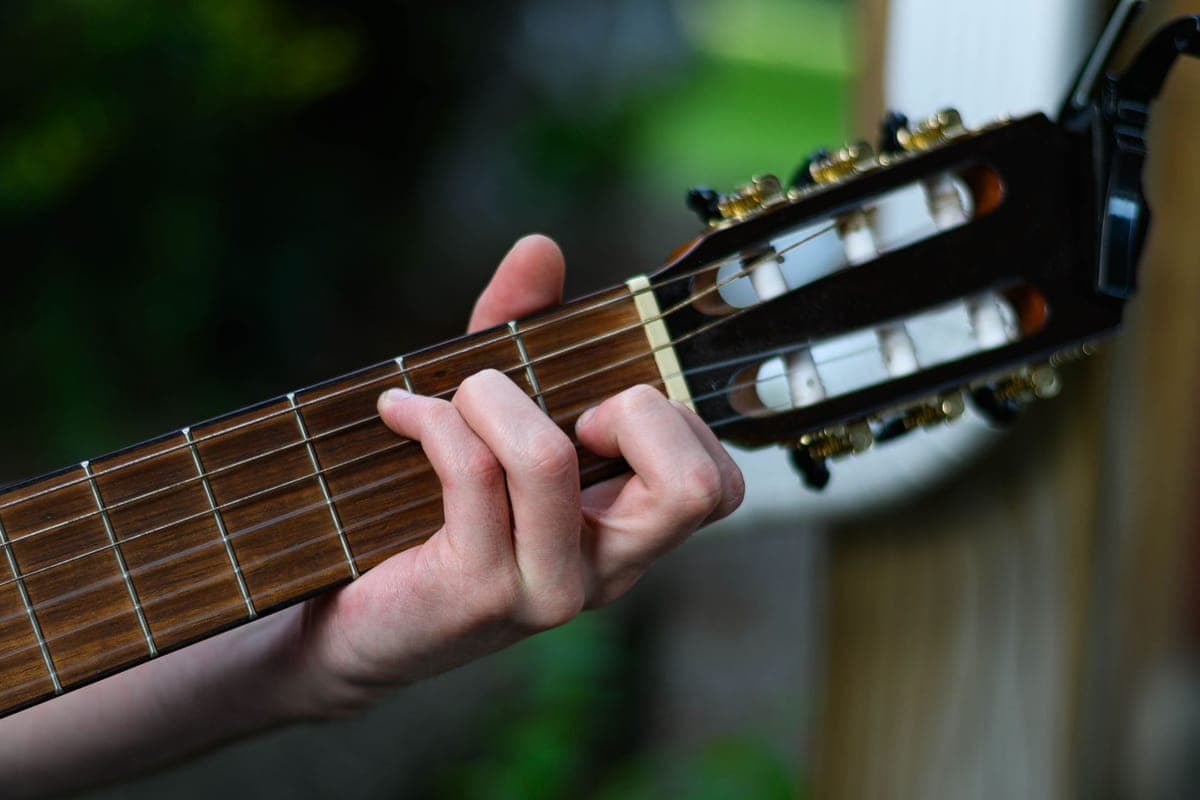
Capos are sold as though one product fits every guitar, and for a nylon-string instrument that is measurably untrue. Two specifications decide it, and only one of them gets discussed: the shape of the bar that presses the strings, and how wide that bar is.
The width is the part that catches people out. What a first classical guitar needs makes the flat-versus-curved argument; this page adds the numbers, the models, and an honest account of what the makers do and do not publish about any of it.
What the makers actually publish
Yamaha is useful here because it publishes full specifications for both kinds of guitar. For its C Series classical guitars it publishes a nut width of 52 mm (2 1/16 in) and a fingerboard radius of Flat. For its A Series steel-string acoustics it publishes a nut width of 43 mm (1 11/16 in) and a radius of R400 mm (15 3/4 in). Same manufacturer, same spec sheet format, two different instruments.
The capo makers agree on the principle. Shubb's FAQ answers "does fretboard radius matter when choosing a capo?" with "yes", lists classical guitars as having flat fretboards, and says using a capo with the correct curvature "ensures even pressure across all the strings". G7th's FAQ says the vast majority of classical guitars have a flat, wide fingerboard and that it makes a dedicated classical capo in each of its ranges. Acoustic Guitar magazine puts the buyer's version plainly: if the capo curvature does not match the fingerboard radius, your outer or inner strings might buzz or stretch out of tune.
52 mm vs 43 mm
Nut width Yamaha publishes for its C Series classical and its A Series steel-string
The same spec sheets give the classical fingerboard radius as Flat and the steel-string as R400 mm (15 3/4 in). The capo has to cover nine more millimeters of neck, flat.
The honest caveat, from a capo maker
It would be neat to say a steel-string capo simply does not work on a classical guitar. Shubb, whose classical capo wins this page, argues the opposite about curvature in general. Its radius page says the rubber is resilient enough to adapt to a wide range of radii, that one professional it names uses a single capo on instruments with both flat and radiused fretboards, and that when the capo is engaged it rests on the tops of the strings rather than on the fretboard itself. On an older Shubb page the company says a mismatch is "in many cases, not a big problem", while adding that you would probably prefer the model made to fit your fretboard.
So the fair version is this: the shape mismatch is a real effect that capo makers design around, and the marginal case is survivable. The width is not survivable in the same way. A bar that does not reach across the strings cannot hold the ones it does not cover.
The criteria, in the order they decide it
1. Width, and the test Shubb publishes for it
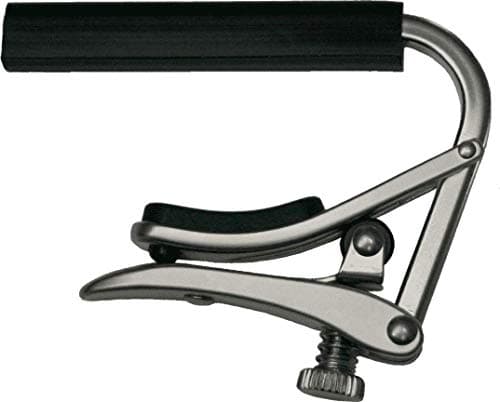
Shubb publishes the most useful single instruction in this category: measure the span of the strings at the highest fret where you would use the capo, and if it is less than two inches a standard steel-string model will cover it. Its nylon-string capos are 2.25 inches wide and flat, which Shubb says fits a classical guitar, a flamenco guitar, some folk guitars and other instruments with a wide, flat fretboard.
G7th publishes the other width figure on this page: a 65 mm (2.5 in) string pad on the Performance 3 Classical, which it says suits classical, flamenco and wider-neck guitars including seven- and eight-string electrics. D'Addario, Kyser and Dunlop publish no width figure at all for their classical capos, which means fit is the one thing you cannot check before it arrives.
2. Flat bar, or a pad that adapts
Four of the five here use a fixed flat bar and say so. D'Addario states its Classical Pro Capo is designed for classical guitars and instruments with flat, non-radiused fingerboards. Dunlop calls the 88B a flat-radius classical capo in the product name itself. Shubb's page subhead reads "For nylon string guitars. Wide, flat fretboard."
G7th does something different, and it is worth understanding before you pay three times as much for it. G7th never calls the Performance 3 Classical pad flat. It describes an ART pad that mechanically adapts to the curvature it finds, and says the capo is for classical, flamenco and wider-neck guitars "including flat and radiused fingerboards". Its own launch announcement gives the reason: G7th says there has been a significant increase in the number of classical and other nylon-strung guitars with a radiused fingerboard.
That is the buying rule. If your nylon-string guitar has a flat board, a flat bar is the cheaper and completely adequate answer. If you do not know, or you already know the board is slightly curved, the adaptive pad is what you are paying for.
3. How the tension is set
Three mechanisms, and they are not equivalent on a light nylon-string setup.
A screw — Shubb and D'Addario — sets the pressure once for your neck and keeps it there. Shubb explains the stakes in its FAQ: too much pressure can pull the strings sharp, too little can cause buzzing, and the screw exists so you can apply exactly the right amount. D'Addario describes the same idea as a micrometer adjustment for the exact tension needed without excessive force.
A squeeze — G7th's Unique Tension Control — lets you choose the pressure as you attach it, then holds it. G7th's argument for ART is that adjustable pressure alone does not fix tuning, because the problem is pressure that is not evenly distributed.
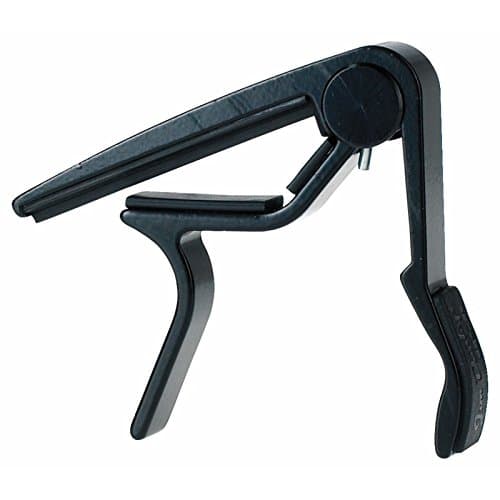
A spring — Kyser and Dunlop — applies whatever the spring applies. That is the fastest to use and the least controllable, and on nylon strings at low tension it is the design most likely to give you more pressure than the instrument needs.
4. One hand, or one setting
Kyser is explicit that its capos transpose quickly using only one hand. Dunlop describes changing key with a squeeze of the hand. Shubb describes one smooth flip of the lever, but never uses the phrase one-handed, and the screw means it is really set for a neck rather than adjusted per song. D'Addario's screw capo is the same trade.
If you play written classical repertoire, the capo goes on before you start and stays there. If you accompany singing and change key between songs, the trigger capos earn their keep.
5. What the warranty says, because it varies wildly
This is the widest spread we have found in any accessory category. Kyser publishes a full lifetime guarantee: if the capo ever fails, it repairs or replaces it. G7th publishes a free lifetime warranty requiring online registration, with wear-and-tear and finish exclusions. D'Addario publishes a one-year limited warranty. Dunlop publishes no capo warranty at all — its warranty page covers Dunlop Electronics for one year and does not mention capos. Shubb is the odd one out and says so: it has never published a written guarantee, and instead promises on its warranty page to repair a capo for the cost of postage.
Published specifications, side by side
What each maker publishes for its classical capo| Capo | Pad | Width | Tension | Warranty |
|---|
| Shubb C2 | Flat | 2.25 in | Screw, set once | None published |
| D'Addario Classical Pro (PW-CP-04) | Flat, non-radiused | Not published | Micrometer screw | 1 year |
| G7th Performance 3 Classical | ART, adapts | 65 mm (2.5 in) | Squeeze | Lifetime, registration |
| Kyser KGCB | Flat, in metadata only | Not published | Spring, fixed | Lifetime |
| Dunlop 88B Trigger Classical | Flat-radius | Not published | Spring, fixed | None published |
Two columns are mostly empty, and that is the finding. Not one maker here publishes a fingerboard radius figure for a classical capo, and only two publish a width. Everything else circulating as a specification — weights, radius ranges, neck-depth limits — comes from retail listings rather than the companies that built the product.
The picks
Shubb C2 — best classical capo
The C2 is the C1 that wins the acoustic capo roundup with the one change a nylon-string guitar needs: a bar that is flat and 2.25 inches wide rather than curved and narrower. Shubb publishes that width, publishes solid brass construction, and publishes the clearest explanation of why the adjusting screw exists.
It is the only capo here that combines a stated flat bar, a stated width and adjustable pressure. For a classical guitar that gets capoed and left there, that is the whole job.
Against it: Shubb publishes no written warranty, which on paper is weaker than Kyser and G7th even though the company promises repairs. It is slower to move than a trigger capo. And like every capo here, it has no published radius figure — "flat" is the entire geometry spec you get.
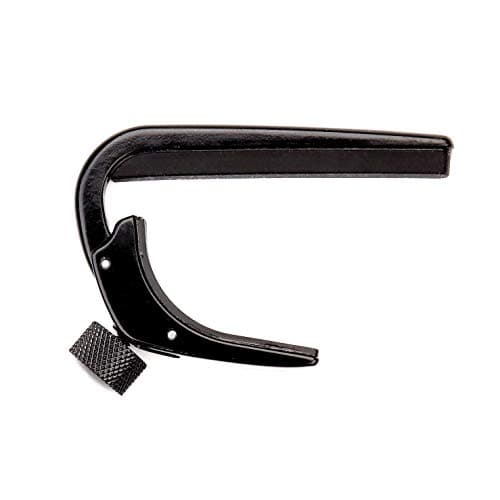
D'Addario Classical Pro Capo — best adjustable tension for less
The same basic argument as the Shubb at a lower price: a micrometer screw that sets exact tension, aircraft-grade aluminum, and a plainly stated design intent of classical guitars and instruments with flat, non-radiused fingerboards. It also carries a published one-year warranty, which two capos on this page cannot match.
Against it: no bar width published anywhere, so on a particularly wide neck you are buying unverified. No radius figure and no weight. And a screw capo is slow if you move it between songs.
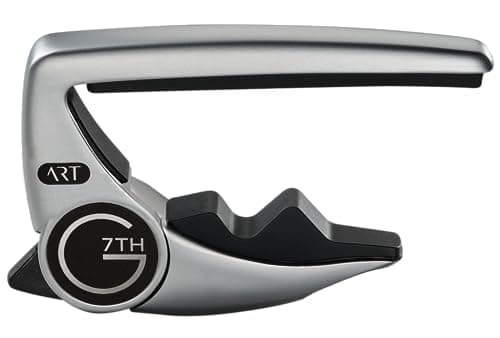
G7th Performance 3 Classical — best on an unmeasured neck
The premium option, and the only one whose pad is not a fixed shape. G7th publishes a 65 mm pad, silicone at every touchpoint, a lifetime warranty with registration, and a replaceable ART pad sold as a spare part. If your nylon-string guitar has a radiused board — which G7th says is increasingly common — this is the capo that handles it without you having to know the number.
Against it: it costs several times what a flat bar costs, and if your board really is flat you are paying for adaptation you do not need. G7th publishes no radius figures, no weight and no model number on its own site. The Amazon listing adds a neck-depth limit that g7th.com does not publish, and we have not used that figure as a specification here.
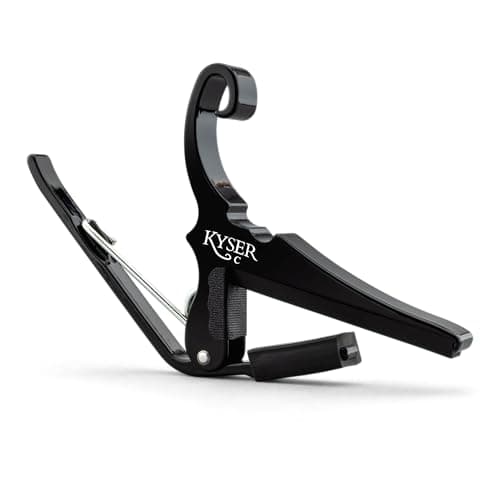
Kyser Quick-Change Classical — best one-handed
Kyser states one-handed use, aircraft-grade aluminum, a full lifetime guarantee and a US factory in Canton, Texas. No other maker on this page states where its capo is made. If you accompany singers and change key constantly, this is the mechanism you want.
Against it: the flat profile appears only in the page's metadata, not in the description a buyer reads, which is a strange gap for the one specification that defines a classical capo. The spring applies fixed pressure with no way to reduce it. And no width, weight or radius figure is published at all.
Dunlop 88B Trigger Classical Flat — cheapest flat capo from a known brand
Dunlop names the flat radius in the product title and repeats it in the description, publishes aircraft-grade aluminum and padding on the neck side, and sells it for less than anything else here. As a first capo for a nylon-string guitar, it is a defensible way to find out whether you use one at all.
Against it: fixed spring pressure, no adjustment. Dunlop publishes no warranty that covers capos. And nothing about fit — width, weight, radius — is published, so the only fit claim is the word flat.
Fitting a capo to a nylon-string guitar
Behind the fret, not on it. The fret does the work, and the capo only has to hold the string against it. How to use a capo covers placement and the retune check in full.
Use the least pressure that stops the buzz. On an adjustable capo, tighten until the buzz disappears and no further. Shubb's own framing is the one to remember: too much pulls sharp, too little buzzes.
Check tuning after it goes on, every time. Nylon strings are thick and low-tension, and they move. A clip-on tuner makes this a two-second habit — see the acoustic tuner roundup.
Take it off when you are done. Leaving any capo clamped on holds the strings against the frets under constant pressure for no benefit.
What we would actually buy
A first classical guitar with a flat board: the Shubb C2, or the D'Addario Classical Pro if you would rather spend less and accept an unpublished width. Accompanying singing with constant key changes: the Kyser, accepting fixed spring pressure. A nylon-string guitar with a radiused fingerboard, or one you have not measured: the G7th Performance 3 Classical. Finding out whether you need a capo at all: the Dunlop 88B, and read do I need a capo as a beginner first, because the honest answer for month one is often no.
What we did not doWe have not played any of this gear. Every guide in this category says it tested twenty tuners; we would rather say plainly that we tested none. What we did instead is on this page in full: published specifications with their sources, the makers' own manuals read rather than paraphrased, and a note wherever a company publishes nothing at all.