Search for a capo and you get a wall of products that look broadly alike and cost anything from a few dollars to the price of a set of strings several times over. The thing separating them is not the brand. It is the mechanism that presses the bar onto the strings, and there are only four of them in general sale.
This page sets out each one in the maker's own published words, because the usual summaries online attribute claims to manufacturers that the manufacturers never made.
1. Spring, also called trigger
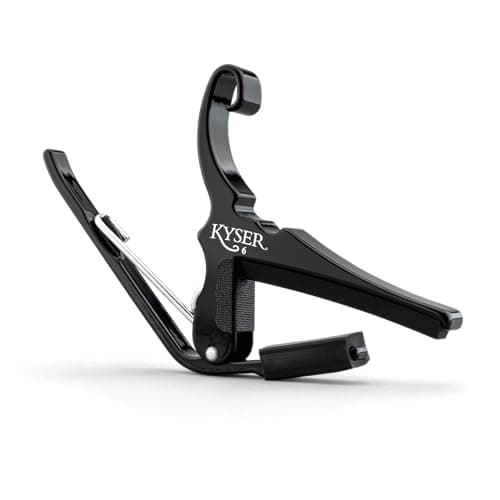
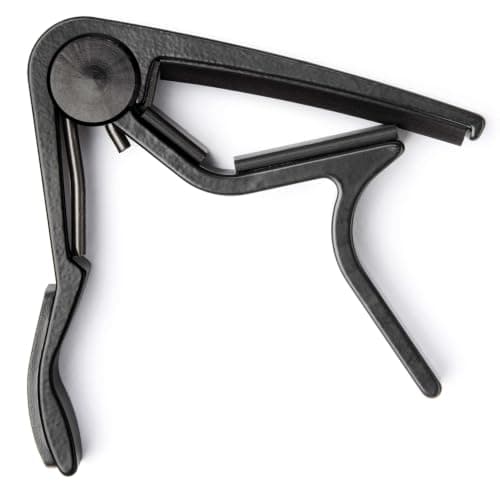
Squeeze the handle, the jaw opens, let go and a spring clamps it shut. Dunlop describes its Trigger as having a "strong spring-action clamp" that you fit "with a squeeze of the hand", and the newer Trigger Fly as using "a specially engineered custom spring mechanism" that "applies balanced pressure for easy placement and precise intonation up and down the neck". Kyser states the practical benefit: its capos "make transposing quick and easy using only one hand".
What the makers do not say. Reviews routinely call spring capos "fixed tension". Neither Dunlop nor Kyser uses that phrase, and neither publishes a clamping force. The closest evidence is Kyser's own Low-Tension model, sold as having "a low-tension spring" giving "gentler pressure on the strings, which prevents any unwanted buzzing or muting" — which only makes sense if the standard spring is one value you cannot change. We would rather point at that than quote a spec nobody published.
2. Screw, on an over-center lever
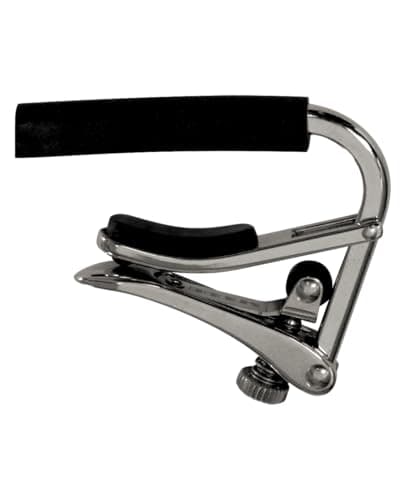
A knurled screw sets how far the bar travels; a lever locks it over center. Shubb's framing is the clearest published description of why anyone would want that: "Once the adjusting screw is set for your instrument, you will get the same, ideal pressure each time." Shubb calls it set it and forget it.
Shubb also publishes the argument for the closing action itself: because the capo closes onto the neck "just like your hand does" rather than like a clothespin or a vise, "there is no sideways pull on the strings". And on the rubber, Shubb says it worked with a laboratory to formulate a material that behaves like the flesh of a fingertip, letting the string sink in rather than being stretched across the fret.
The trade is time. Shubb publishes no one-handed claim anywhere, and the screw has to be set for each different neck.
3. Squeeze, with tension control
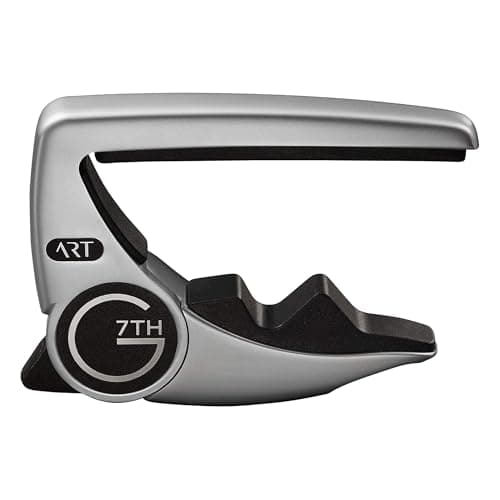
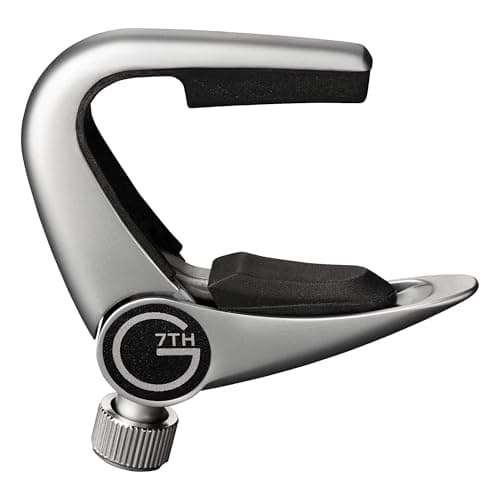
G7th's Performance range squeezes on like a spring capo but holds whatever pressure you applied. The mechanism has a name and G7th publishes it: a wrap-spring clutch, which lets the arms rotate closed freely but grips when they try to open, releasing when you squeeze the lever.
That gives, in G7th's words, "extremely intuitive and infinite control over the pressure placed on your strings". G7th also makes the only direct speed comparison any maker publishes: a Performance 3 "can be moved with one hand between frets nearly as quickly as a spring capo, but without the need for frequent retuning".
4. Toggle, on a strap
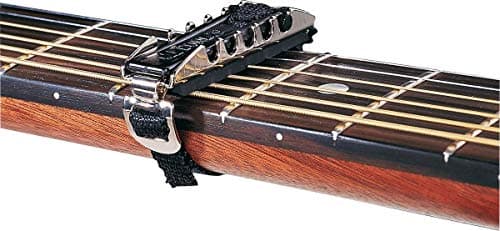
The oldest design still widely sold: a strap passes round the neck and a toggle locks it at the length you choose. Dunlop's published description is one sentence — "light and simple to use, featuring an adjustable strap and a sleek ergonomic profile that won't scratch up your guitar neck" — and that is genuinely all Dunlop publishes. No explanation of the action, no tuning claim, no speed claim, no warranty.
It is the cheapest way to get adjustable pressure, and the slowest mechanism to use.
The fifth thing on the shelf: partial capos
A partial capo is not a mechanism, it is a different instruction. It covers some strings and deliberately misses others. G7th's Newport 3-string partial publishes the usual recipe: clamp A, D and G at fret 2 for a DADGAD-style effect, or turn it over on D, G and B for an open G style, then flip the lever and you are back in standard tuning. Shubb's partials do the same job with a crook in the frame that skips the outside string without buzzing.
It does not transpose your guitar, so it never replaces a full capo.
4 mechanisms
Capo designs in general sale: spring, screw, squeeze and toggle strap
Only two of them let you choose the pressure. That single distinction explains most of the price range in the category, and most of the tuning complaints.
How the mechanisms compare
Published behavior by mechanism| Mechanism | Pressure | Speed | Maker's tuning claim | Typical price tier |
|---|
| Spring / trigger | Set by the spring | Fastest, one-handed (Kyser states it) | Dunlop: balanced pressure, precise intonation | Entry |
| Screw / over-center | You set it, once | Slowest of the clamps | Shubb: same ideal pressure every time, no sideways pull | Entry to mid |
| Squeeze / tension control | You set it each time | Near spring speed, per G7th | G7th: without the need for frequent retuning | Upgrade |
| Toggle / strap | You set the strap | Slowest overall | None published | Entry |
| Partial | Depends on the model | As its mechanism | Re-voices rather than transposes | Mid to upgrade |
Which mechanism suits which player
You own one guitar and play sitting down
A screw capo. You set it once for that neck and it repeats. This is also the mechanism with the most published reasoning behind it.
You accompany singing and change key between songs
A spring capo. One hand, no setting, and the speed is the point. Accept that the pressure is whatever the spring gives.
You move between guitars with different necks
A squeeze capo. Different necks want different pressure, and the wrap-spring clutch lets you choose it each time without a screwdriver moment on stage.
You are not sure you will use a capo at all
A toggle strap capo costs very little and adjusts. Do I need a capo as a beginner answers the prior question honestly, and the answer for month one is often no.
The picks
Shubb C1 — best screw capo
The reference screw capo, and the one whose maker explains the mechanism in the most detail: set the screw once for your instrument and get the same pressure every time, with a closing action Shubb says avoids pulling strings sideways.
Against it: slower than any trigger, the setting has to be redone for a different neck, and Shubb publishes no written warranty.
G7th Performance 3 — best squeeze capo
Squeeze on, squeeze off, with the pressure you chose held by a wrap-spring clutch, plus the ART pad that adapts to the fingerboard curve. The only capo here whose maker publishes both a mechanism name and a speed comparison.
Against it: several times the price of a spring capo, and the tension you apply is only as good as your judgment each time you fit it.
Kyser Quick-Change — best spring capo
The one-handed standard, guaranteed for life in writing, made in Kyser's own Texas factory. If the capo moves every few songs, this is the mechanism that keeps up.
Against it: no way to reduce the pressure, and Kyser sells a separate low-tension model rather than making this one adjustable.
Dunlop Trigger — cheapest spring capo
The same idea for less money, in aluminum, with the padding published and the squeeze-on action that made it the live standard.
Against it: Dunlop publishes no warranty covering capos, no clamping force, and the curved and flat versions are separate products you can buy wrong.
Dunlop Professional Toggle 14F — cheapest adjustable capo
A strap and a toggle, nickel-plated, for less than a pack of strings. It adjusts, which no spring capo at this price does.
Against it: Dunlop publishes nothing about how the toggle works or what it achieves, it is the slowest to move, and the flat version is for flat fingerboards only.
G7th Newport 3-String Partial — best partial capo
For open-tuning voicings without retuning: three strings covered, the rest ringing, and a flip lever whose tension can be adjusted on the neck.
Against it: it does not transpose, so it is an addition to your capo rather than a replacement, and it costs more than most full capos here.
What changes nothing, whichever you buy
Placement. Right behind the fret, not on top of it and not halfway back. Further back needs more pressure, and pressure is what pulls strings sharp.
Curvature. The bar should match your fingerboard. That is why classical capos are flat and electric capos are more curved than acoustic ones.
Retuning. Check tuning after the capo goes on, every time, whatever the marketing says.
What we would actually buy
One guitar, mostly at home: the Shubb C1. Live key changes: the Kyser, or the Dunlop Trigger if the budget is tight. Several guitars with different necks: the G7th Performance 3. Testing whether you use a capo at all: the Dunlop toggle. Chasing open-tuning sounds in standard tuning: the Newport partial, as a second capo rather than a first.
What we did not doWe have not played any of this gear. Every guide in this category says it tested twenty tuners; we would rather say plainly that we tested none. What we did instead is on this page in full: published specifications with their sources, the makers' own manuals read rather than paraphrased, and a note wherever a company publishes nothing at all.