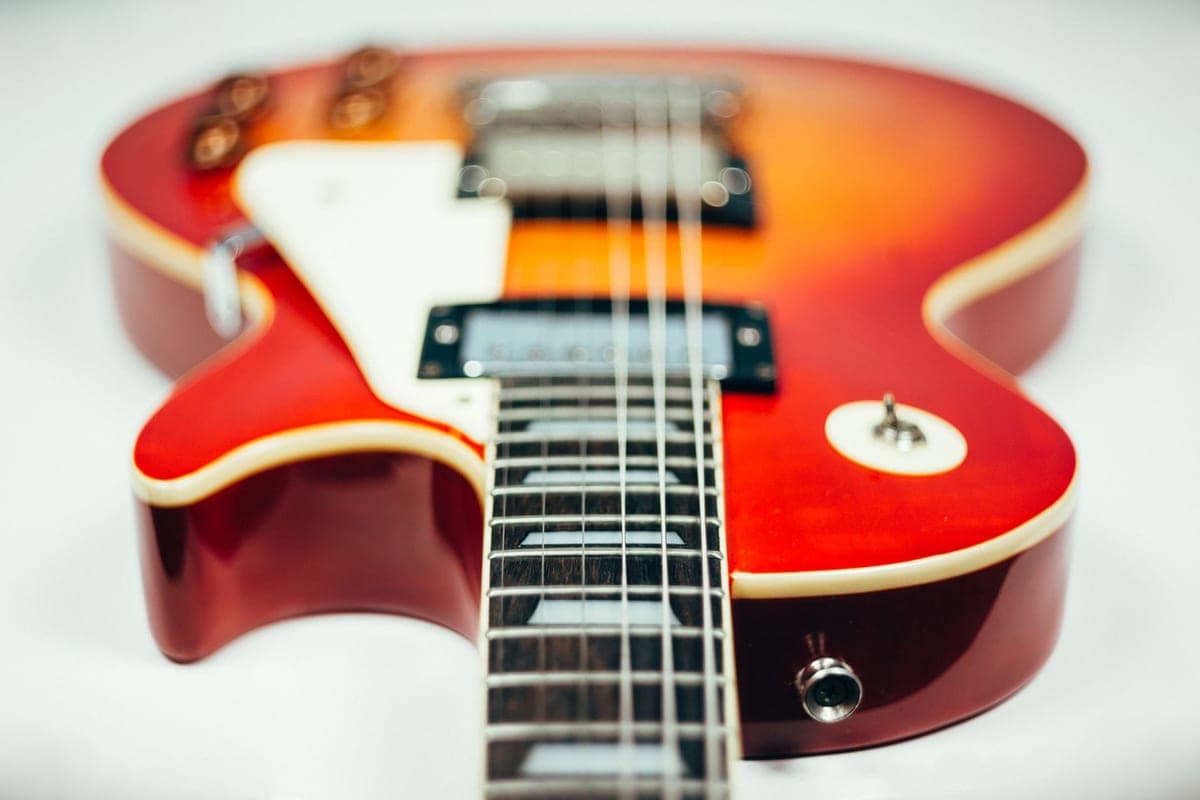
Frets go gray because nickel silver oxidizes, and because sweat and skin oil sit on them between playing sessions. That is cosmetic, it affects how a string slides under a bend, and it cleans off.
Frets also wear: flats on top, grooves under the strings, divots in the first positions. That is not cleaning, it is repair, and the honest thing a buyer's guide can do is tell you which one you are looking at before you spend anything.
Which problem do you have?
Gray or brown frets, smooth to the touch. Oxidation and grime. A polish and a guard will bring them back.
Frets with visible flats or a dip under each string. Wear. Polishing makes worn frets shiny and still worn, and it can make a buzz worse by removing a whisker more material. The fret buzz page covers how to tell whether a single high or worn fret is causing your problem.
Sharp fret ends catching your hand. Fret sprout, usually from a dry winter. That is fret-end dressing, not polishing, and MusicNomad scopes its abrasive kit to exactly that kind of work. Fret sprout is the page for it, including the two kinds of neck you should not file and the sentence Taylor publishes about humidity not undoing it.
What the makers publish, and what they carefully do not
No maker publishes a fret-polishing interval. MusicNomad publishes a fretboard cleaning interval — every six months — and an F-ONE oil interval of four to six months for daily players, but nothing about how often to polish frets.
No maker publishes a warning about removing fret material either. The closest thing to a position is MusicNomad scoping its Micro-Mesh kit to work after crowning, beveling and dressing, and describing its polish as micro-fine compounds rather than an abrasive. We would rather say that plainly than invent a rule and attribute it to a manufacturer.
1000 to 12000
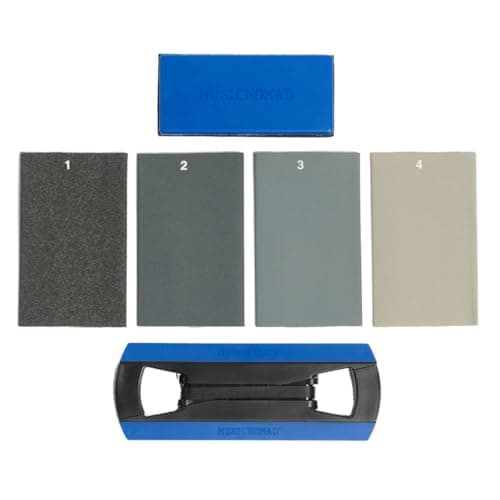
The Micro-Mesh grit range MusicNomad publishes for its Tracers kit
Those four grades are numbered 1 to 4 in the order you use them. It is the only published grit information in this category, and it belongs to the kit scoped for work after fret dressing — not to routine cleaning.
The criteria, in the order they decide it
1. Does it include fretboard guards, and will they fit?
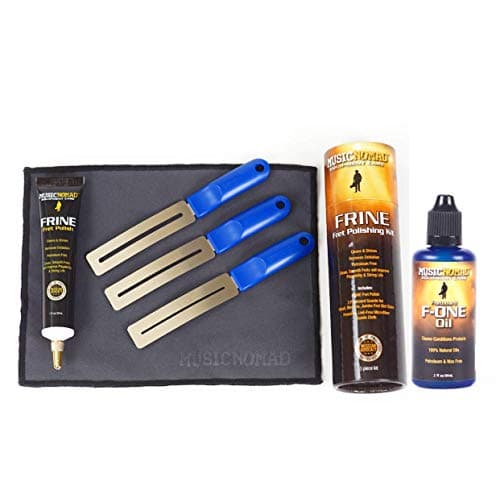
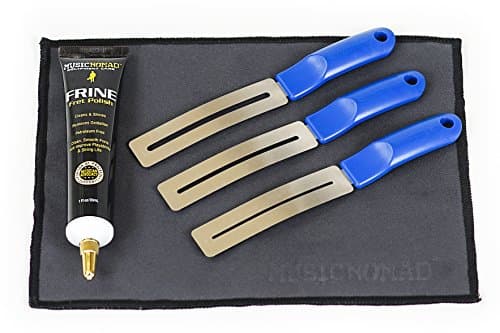
A guard is a thin metal shim that slots over one fret so polish and abrasive never touch the wood. Without one you are rubbing compound into a porous fretboard. MusicNomad includes three guards — small, medium and jumbo fret slot sizes — in both the MN124 and MN144 kits, and publishes the fit limit as a 2.60 in (66 mm) fret slot length. Measure your first and last fret: if neither exceeds that, the guards fit.
2. Polish or abrasive?
FRINE polish is described as micro-fine polishing compounds that remove oxidation, dirt and oil, positioned as the alternative to harsh cleaners and steel wool. The Tracers pads are graded abrasives that cut. Those are different tools for different jobs, and the abrasive one is the one to be careful with.
3. Is the kit scoped to your job?
MusicNomad is refreshingly explicit that the Tracers kit is for polishing out frets "after fret crowning, fret beveling, fret dressing or fixing fret sprout". If you have not done any of those, you are buying a finishing tool for a job you have not started.
4. Does it also handle the fretboard?
The board is exposed while the guards are out, so combining the jobs saves a session. MN144 adds F-ONE oil for unfinished boards — MusicNomad says that includes maple — while publishing the exclusion that matters: a seal of any kind over the wood blocks the oil, so it is not for finished or matte-sealed boards. Fretboard oil covers that decision on its own.
5. What is actually in the box
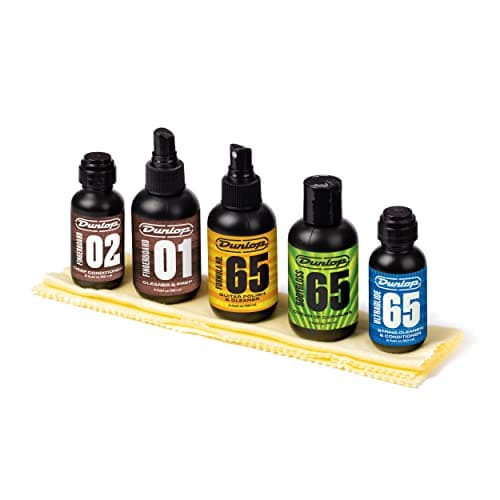
Read contents lists rather than category names. Dunlop's System 65 is an excellent general care kit — body polish, carnauba, string conditioner and a two-stage fingerboard treatment — but its published contents include nothing for frets, even though several retailer listings for the same kit claim a fret polishing cloth. We go with what the maker publishes.
Published contents, side by side
What each kit publishes| Kit | Fret polish | Abrasive grits | Guards | Fretboard oil |
|---|
| MusicNomad MN124 FRINE | Yes, 1 fl oz | Not published | 3 sizes | No |
| MusicNomad MN144 Total | Yes | Not published | 3 sizes | Yes, F-ONE |
| MusicNomad MN860 Tracers | No | 1000 / 3600 / 6000 / 12000 | None | No |
| Dunlop System 65 (6500) | None published | None | None | Yes, two-stage |
The picks
MusicNomad MN124 FRINE kit — best fret polishing kit
The complete routine job in one box: polish, three stainless guards covering small to jumbo frets, and a suede microfiber cloth. It is the cheapest way to clean frets properly, and the guards mean you are not scrubbing compound into the fretboard.
Against it: no grit or abrasive level published, the guards top out at a 2.60 in fret slot, and polishing does nothing for a fret that is actually worn.
MusicNomad MN144 Total Fretboard Care — best frets-and-fretboard kit
The same fret kit with F-ONE oil added, which is how most people should do this job: clean the board, oil it if it is unfinished, polish the frets while the guards are already in hand.
Against it: component volumes are not published, it costs more than the fret kit alone, and the oil is useless on a sealed or matte board — which MusicNomad says itself.
MusicNomad MN860 Tracers — best after fretwork
Four graded Micro-Mesh abrasives, numbered in sequence, with separate handles for fret tops and fret ends. If you have just had frets dressed, or you are fixing sprout, this is the finishing tool and its grits are published.
Against it: it is an abrasive kit for a job most owners never do, it includes no fretboard guards, and it is the most expensive item here.
Dunlop System 65 — best all-round care kit
Five products and two cloths covering body, strings and fingerboard, from a brand that has been selling this kit for decades. As a general maintenance box it is good value.
Against it: no fret content in Dunlop's published list, no volumes, and no maple or sealed-board guidance. Buy it as a care kit, not a fret kit.
Doing the job without damaging anything
Take the strings off, or at least slacken and move them aside. You cannot guard a fret with a string across it.
Use the guard on every fret, every time. It is the difference between cleaning metal and polishing wood.
Work along the fret, not across it. Following the length of the wire keeps any marks in line with the way light runs along it.
Stop when they are clean. Extra passes remove metal for no benefit. If they are still dull after the tarnish is gone, they are worn, not dirty.
Then clean the board. How to clean your guitar covers the rest of the instrument, and the cleaning kit roundup compares the all-in-one boxes.
What we would actually buy
Gray frets, everything else fine: the MN124 kit. Doing the fretboard in the same session on an unfinished board: the MN144. Just had fret work done, or fixing sharp fret ends: the Tracers kit. Wanting one box for the whole guitar, with frets not the priority: the Dunlop System 65, knowing it contains nothing for frets.
What we did not doWe have not played any of this gear. Every guide in this category says it tested twenty tuners; we would rather say plainly that we tested none. What we did instead is on this page in full: published specifications with their sources, the makers' own manuals read rather than paraphrased, and a note wherever a company publishes nothing at all.