Nothing exposes a player's timing like a click that does not move. It is uncomfortable, it is the fastest way to improve, and it is the accessory most likely to sit unused in a drawer.
The honest starting question is whether you need a dedicated one at all, since a free phone app does the core job.
The case for a dedicated metronome
It is not a phone. A phone in your hands during practice is a notification-delivery device. A metronome is a metronome. This is not a technical argument and it is the one that persuades most people who make the switch.
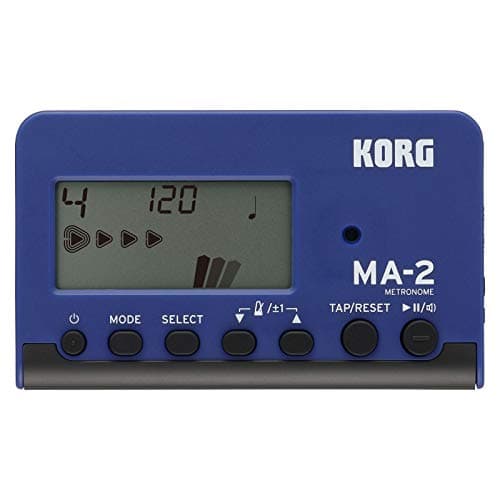
A headphone jack. Korg publishes a 3.5 mm stereo headphone output on the MA-2, which means the click can go into the same practice headphones as a headphone amp. That combination — silent guitar and click together — is genuinely useful and awkward to arrange with a phone.
Published accuracy. Korg publishes ±0.02% tempo accuracy for the MA-2. Very few phone apps publish anything, and app timing depends on the device's audio scheduling.
Battery life measured in hundreds of hours. Korg publishes approximately 400 hours from two AAA alkaline cells at tempo 120, four beats, maximum volume — a properly specified figure with its test conditions stated.
Korg MA-2 published specifications| Specification | Published value |
|---|
| Tempo range | 30–252 bpm |
| Tempo accuracy | ±0.02% |
| Tempo setting | Pendulum step, full step, tap tempo |
| Beats | 0–9, with eight rhythm patterns |
| Reference tone | C4 (261.63 Hz) to B4 (493.88 Hz), one octave |
| Calibration | A4 = 410–480 Hz |
| Tone accuracy | Under 1 cent |
| Power | 2 × AAA, 3 V |
| Battery life | Approx. 100 h zinc-carbon, 400 h alkaline |
| Dimensions | 100 × 60 × 16 mm (3.94 × 2.36 × 0.63") |
| Weight | 68 g (2.4 oz) with batteries |
±0.02%
Korg's published tempo accuracy for the MA-2
At 120 bpm that is a deviation of well under a millisecond per beat. Almost no phone app publishes any figure at all.
The case against — an app is genuinely fine
A metronome click is a click. If a free app on a device you already own gets you practicing to a steady pulse, that is the whole benefit captured for nothing.
The real failure mode in this category is not app-versus-hardware. It is buying a metronome and never using it. If you have not yet built the habit of practicing to a click, build the habit with the free option first, and buy hardware when you find yourself reaching for it daily.
What separates the two dedicated units
The Korg MA-2 publishes everything: tempo range, accuracy, beats, reference tone, calibration range, battery life, dimensions and weight. It is the most fully specified product on this entire site, which is why it ranks first.
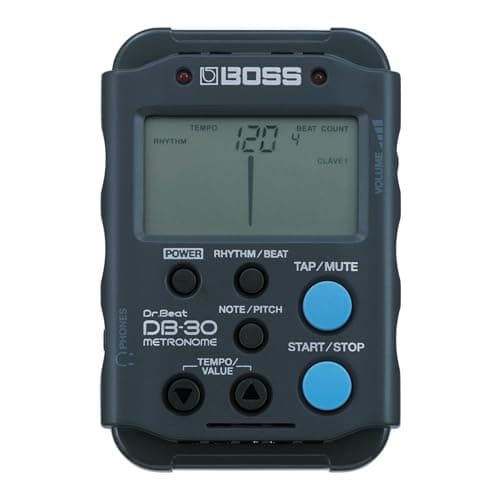
The Boss DB-30 offers a wider set of rhythm patterns and a built-in reference tone in a small unit with Boss build quality. Boss publishes less about it than Korg does about the MA-2, and its published battery life is shorter.
How to actually use one
Start slower than feels reasonable. If you can play something at 60 bpm cleanly, you can build to 120. If you start at 120 and play it messily, you are practicing playing it messily.
Click on beats 2 and 4 once the basics are steady. Halving the click density forces you to keep time internally, and it is a much better test than a click on every beat.
Use the reference tone. Korg publishes a C4–B4 reference tone with a 410–480 Hz calibration range. Tuning by ear against it, then checking with a clip-on tuner, is one of the better ways to develop pitch recognition.
What we did not doWe have not played any of this gear. Every guide in this category says it tested twenty tuners; we would rather say plainly that we tested none. What we did instead is on this page in full: published specifications with their sources, the makers' own manuals read rather than paraphrased, and a note wherever a company publishes nothing at all.