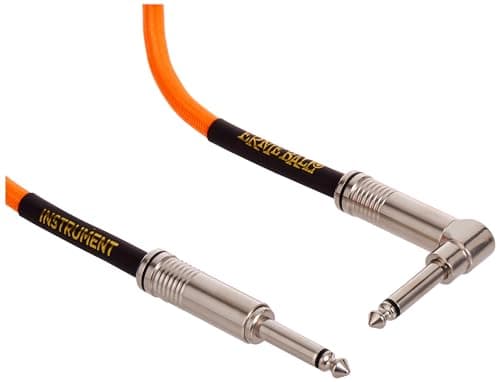
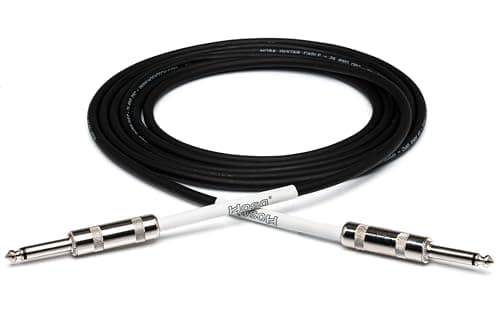
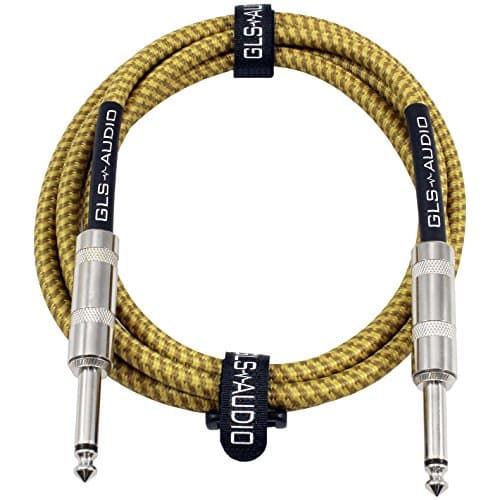
No — use each for its own job. A speaker cable plugged into your guitar works, and hums, because it has no shielding. An instrument cable run between an amp head and a speaker cabinet is the swap that costs money: Fender publishes that it can produce "reduced speaker output, some probable distortion and, in extreme situations, heat-induced cable or cable connector failure". For a guitar, buy an instrument cable — the Ernie Ball braided one if you coil it daily, the Hosa GTR-210 as a spare.
If you play a combo amp and have never seen a speaker cable, you can stop here: everything you own is an instrument cable. This page is for the moment somebody hands you an unlabeled lead, or you buy a head and a cabinet.
What is inside each one
Fender publishes the construction of both, and the figures are the whole argument.
- Instrument cable: "a single small-diameter 'positive' inner wire (usually 24 gauge) running through a braided shield conductor that works as the ground connection". It is built to carry "a weak unamplified signal" — low power, high impedance.
- Speaker cable: "not one but two wire conductors, both with a relatively large diameter", carrying "a relatively high AC current and voltage" — high power, low impedance, and no shield at all.
Hosa, which makes both, publishes the same split from the other side: a speaker cable "must be able to handle transferring audio as well as power" and its example conductor is 12 AWG, while an instrument cable needs "more robust braided shielding" because any interference it picks up gets amplified along with the signal. Hosa puts typical braid coverage at 70 to 95 percent.
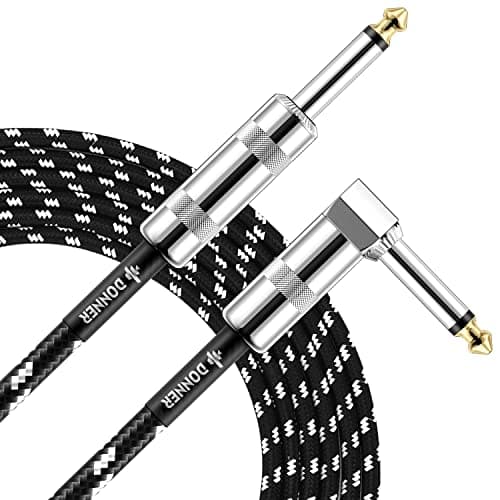
Twelve gauge against twenty-four gauge is not a refinement. Each three steps down the AWG scale roughly doubles the cross-section, so a speaker conductor is many times the copper of an instrument conductor — and the budget guitar cable we recommend, the Donner, publishes exactly the 24 AWG figure Fender names.
24 AWG vs 12 AWG
The published conductor sizes behind the two cables sharing the same 1/4 inch plug
Fender's figure for an instrument cable's inner wire and Hosa's example for a speaker cable. The plug is the only thing the two products have in common.
Swap one: speaker cable into your guitar
This is the harmless-but-annoying direction. Fender's own wording: "the large conductors handle the weak signal just great. But there's a catch — speaker cables aren't shielded." Without a shield the cable collects interference "from fluorescent lighting, amp power supplies and various other external AC sources", and your amp amplifies all of it.
What you hear is a hum or buzz at mains frequency — 60 cycles in the US — that gets worse when you move, when you stand near a dimmer or a laptop charger, and when you turn up. Nothing is damaged. It simply sounds bad, and people spend weeks blaming their pickups for it.
Swap two: instrument cable from an amp head to a cabinet
This is the direction that breaks things, and it is worth understanding rather than memorising.
Fender's analogy is water through a pipe: the amplifier puts out whatever pressure it is capable of, and a narrow pipe restricts the flow. "Smaller-diameter wires present more electrical resistance to the signal flow, wasting energy in the form of heat." At low volume you will probably get away with it. At high volume, in Fender's words, "all that amp power attempts to flow through the instrument cable's too-small conductor" — producing reduced output, distortion, and possible heat-induced failure of the cable or its connectors.
There is a second reason, which Fender does not spell out and which we flag as our own: a valve amp dislikes losing its speaker load. If a thin cable or a melted connector opens the circuit while the amp is driven hard, the damage is to the amp, not just to the lead. That is why amp and cabinet manuals carry this warning at all.
Published differences, and what each swap does | Instrument cable | Speaker cable |
|---|
| Conductors | One inner wire, usually 24 gauge | Two, relatively large diameter |
| Shielding | Braided shield, 70-95% coverage typical | None |
| Carries | Weak, unamplified signal | Amplified high current and voltage |
| Impedance | High | Low |
| Plug | 1/4 in | 1/4 in — the only thing they share |
| Used in the wrong role | Heat, lost output, possible failure | Hum and buzz from interference |
| Risk level | Can damage gear | Annoying only |
Why the plug is the same, and why that is not going to change
The 1/4 inch phone plug predates electric guitars by decades — it came out of telephone switchboards — and it ended up on amplifiers, speakers, instruments and headphones because it was the rugged connector everybody already had. Nobody designed this collision; it is inherited.
The practical consequence is that the industry will not fix it for you. The same plug will keep going on both kinds of cable, which means the responsibility for telling them apart stays with the person holding them. That is worth accepting rather than resenting, because the alternative — guessing — is the thing that costs money.
It also means a cable that fits is not a cable that belongs. Every piece of 1/4 inch gear in a bedroom rig will physically accept every 1/4 inch lead in the room, and about a third of those combinations are wrong.
What to do with the leads you already own
A five-minute sort, once, and the problem is permanently solved.
- Lay every 1/4 inch lead you own on the floor and read the jacket. Most are printed along their length with what they are.
- Count the black rings on the plug. One ring is unbalanced — an instrument or speaker lead. Two rings is a balanced or stereo lead and never belongs between an amp and a speaker.
- Anything that came in the box with a head or a cabinet goes in a separate place from anything that came with a guitar.
- Anything genuinely unidentifiable gets used on the guitar, where the worst case is a hum, and never between an amp and a speaker, where the worst case is an amp.
While they are on the floor, flex each one near the plug and listen for crackle, because the jack is where cables die. That is the whole argument of guitar cables — the failure is mechanical and at the ends, which is why a replacement warranty is worth more than any claim about the copper in the middle.
How to tell them apart when both are in the drawer
Fender names the trap exactly: "confusion sometimes arises from the fact that both kinds of cable often share the same kind of connector — 1/4" phone plugs". There is no reliable way to tell by feel, and we are not going to invent one.
What works is boring and certain. Read the jacket — cables are routinely printed with "instrument", "guitar" or "speaker" along their length. Keep the ones that came with an amp head separate from the ones that came with a guitar. And if a lead is genuinely unidentifiable, use it for the harmless job: the guitar, where the worst case is a hum.
What we did not doWe have not played any of this gear. Every guide in this category says it tested twenty tuners; we would rather say plainly that we tested none. What we did instead is on this page in full: published specifications with their sources, the makers' own manuals read rather than paraphrased, and a note wherever a company publishes nothing at all.
TS, TRS, and the third kind of 1/4 inch plug
There is one more lead in most bags with the same plug on it, and it is neither of the two above. Hosa publishes the distinction clearly enough to settle it by eye.
- TS, tip-sleeve. Unbalanced: "a two-wire system: a signal wire and a ground (shield) wire". Hosa identifies it by "a single black insulator ring" on the plug, and calls TS cables "instrument cables" that are "the standard for guitars, bass, and unbalanced keyboards". This is your guitar lead.
- TRS, tip-ring-sleeve. Balanced, using "three conductors to carry 'hot,' 'cold,' and 'ground' signals", and identified by "two black insulator rings". Also the plug on most headphones, where the two rings carry left and right instead.
Count the black rings on the plug. One ring is an instrument lead; two rings is a balanced or stereo lead; a speaker cable is also one ring and is distinguished by the printing on the jacket rather than by the plug. A TRS lead will physically fit a guitar and will usually work, because the guitar only drives the tip — but it is not what it is for, and on some gear the ring shorting to sleeve causes problems.
Hosa adds a length figure worth carrying across: unbalanced cables "should be kept to short lengths — typically under 15–20 feet" to limit interference pickup. That is a shielding argument, not a tone one, and it is the same reason a speaker cable hums when you play through it.
When this actually comes up for a beginner
- Almost never on a combo amp. A combo has its speaker wired internally. There is no speaker cable in the signal path and nothing to get wrong.
- An extension speaker jack. Some combos have one. Anything plugged into it needs a speaker cable.
- A head and a cabinet. The one place it matters every single time.
- Borrowed or inherited leads. The commonest source of an unlabeled cable in a bedroom.
What a beginner actually needs is a good instrument cable and a spare, which is the argument on guitar cables — where the honest ranking criterion turns out to be the warranty, because the jack is what fails. If the budget is tight, budget guitar cables covers what you give up under fifteen dollars.
The one-sentence version
Fender puts the whole thing in a line worth remembering: "Using one in place of the other can have unpleasant effects ranging from merely annoying interference to outright equipment failure." The interference is the speaker cable in your guitar; the equipment failure is the guitar cable at your speaker. One of those is a bad evening and the other is a repair bill, and the only thing standing between them is which way round you grabbed the lead.
If you need a speaker cable, buy one sold as a speaker cable and keep it with the amp rather than in the guitar bag. We do not rank them here: a speaker lead is amp equipment rather than a first-guitar accessory, and the makers of the instrument cables on this page — Hosa among them — sell both, which is exactly how two very different products end up looking like the same thing in a drawer.
What we would actually buy
For the guitar: the Ernie Ball braided cable if you coil and uncoil it daily, the Hosa GTR-210 as the spare that lives in the case, the Donner if you want a published 24 AWG conductor at the lowest price, and the GLS if you want published oxygen-free copper with a braided jacket. For a head and cabinet, buy a cable sold as a speaker cable and keep it with the amp — it is not an accessory this site covers, and it is not one to improvise.