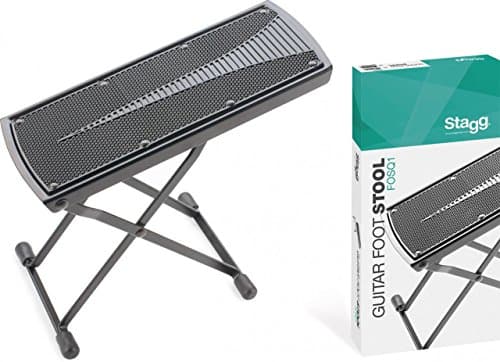
What a first classical guitar needs stops at a sentence it deliberately does not follow up: what raises the leg is a footrest, or a support that fixes to the guitar, and the right height depends on your own proportions. That page declines to name one. This page names five, and explains why the height question is the reason your first one should adjust.
It is a cheap purchase. It is also the only accessory on the classical list that changes how your body sits for every minute you practice, which is a good reason to understand it before buying rather than after.
Do you need one at all?
If you play a steel-string or an electric, probably not. Played casually on the right leg, or standing with a strap, those guitars do not call for raising anything.
If you are learning classical technique, yes, in some form. The classical position holds the guitar higher and at more of an angle than a relaxed seat allows on its own. This is Classical Guitar, Bradford Werner's teaching site, puts the two options simply: with a footstool the left foot is raised and the right foot is on the ground; with a guitar support both feet are flat on the ground. The same page suggests experimenting with the height so the headstock sits around eye level.
If you have a teacher, ask in the first lesson which they prefer, and let them watch you sit before you spend anything beyond the price of an adjustable footstool. That is not a hedge. It is the point every source we read makes in some form: the right height is a fact about your body that nobody can read off a listing.
Footstool or support: the decision that matters
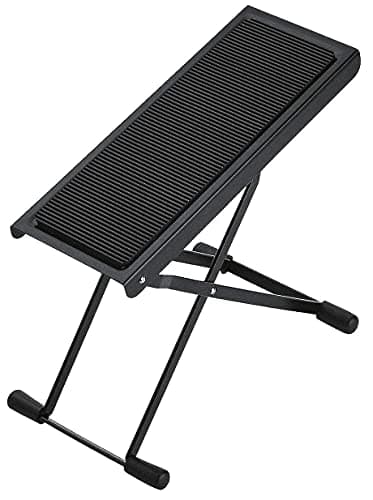
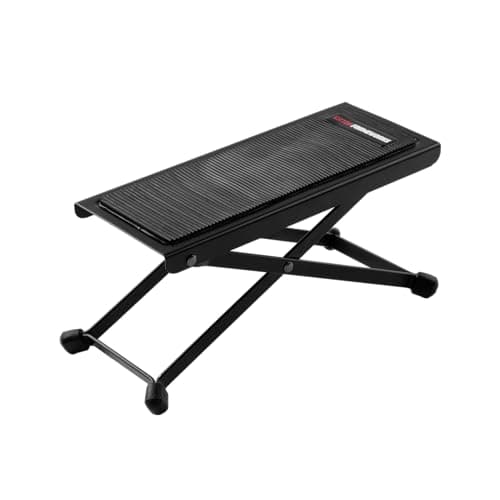
A footstool raises your left leg. The guitar rests on that thigh, which lifts and tilts it. Nothing touches the instrument. The three footstools here fold flat and adjust in steps, and a footstool is the cheaper of the two approaches.
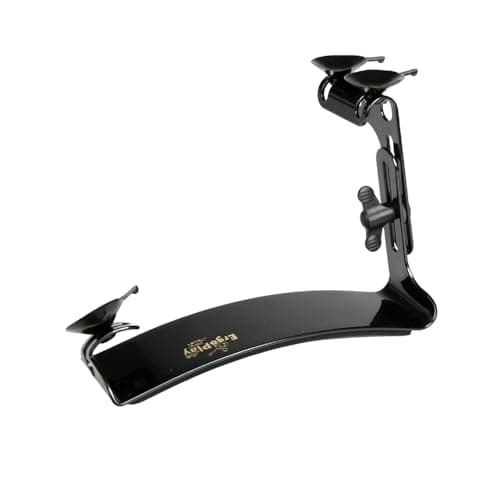
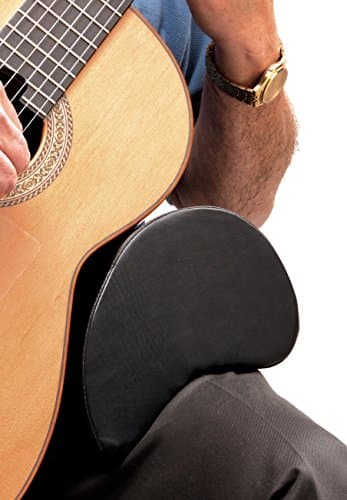
A guitar support raises the guitar instead. Many fix to the side of the body with suction cups and rest on the thigh, so you can keep both feet on the floor. Others are simply a cushion that sits on the leg and does not attach at all.
The argument for a support is posture. Classical Guitar Academy's posture lesson says the main benefit of a support is keeping both feet on the floor, and that raising your foot on a stool for prolonged periods can result in back ache. That is a teaching site's observation rather than a clinical finding, and it describes long sessions, but it is the honest reason people move from one to the other.
The argument for a footstool is everything else. It costs a fraction of a support, it adjusts in steps you can count, it never touches the finish, and it lets you find the height you actually need, which you then know when, or if, you buy a support.
4° to 16°
The range of plate tilt K&M publishes across the 14670's six heights
K&M's instructions tie each of the six heights to its own plate angle, so changing the height also changes how your foot sits. It is the only maker here that publishes the angle as well as the height.
The criteria, in the order they decide it
1. Height range, and the top of it in particular
Every adjustable footstool here starts between about 4.7 and 5.25 inches. Where they differ is how high they go, and the top of the range is the number that matters. This is Classical Guitar says the healthy answer might be a 90-degree angle at the knee, but that most players bring the knee up higher to raise the guitar and create a nook for it to stay in. A tall player doing that can run out of footstool.
Stagg publishes 13.5 to 27 cm, 5.25 to 10.5 inches, for the FOSQ1. K&M publishes 119 to 264 mm, 4.69 to 10.39 inches, for the 14670. Gator publishes 5 to 9.5 inches for its Frameworks footrest. That last inch at the top is the difference between the three.
Supports are measured differently, as lift under the guitar rather than height under the foot, so the two numbers do not compare directly. Oasis publishes about 5.5 inches of lift for the large OH-28. Ergoplay publishes no height range at all for the Tappert.
2. How many positions, and how far apart
Six positions beats five only if the steps land where you need them. K&M is the one maker that publishes the steps themselves: 120, 160, 190, 220, 240 and 265 mm in its instructions. The first jump is 40 mm, the rest are 20 to 30. Stagg publishes six steps and Gator five, without the individual heights.
3. How it meets the floor and your foot
A footstool that slides is worse than none. K&M publishes a non-skid plastic pad and four non-slip parquet protectors on the feet. Gator publishes a rubber pad on top and rubber feet that it says prevent movement and protect floors. Stagg publishes an anti-skid polypropylene top and says nothing about the feet, which we have marked as unpublished on its card rather than assuming.
4. For a support: how it meets the finish
This is where supports carry a risk a footstool never does, and where makers publish more caution than their listings suggest.
Suction cups want a smooth gloss finish. Sagework, which makes suction-cup supports, states plainly that suction cups do not work on non-gloss finishes. Ergoplay sells adhesive films specifically for matte and open-pored finishes, and includes two with the Tappert.
Films are not a free pass. Guitarlift, which sells its own films, says the interaction between shellac and the films varies with the polish, warns against removing them forcefully, and advises anyone playing a historical instrument, or unsure of their finish, to consult a guitar builder first. If you do not know what your finish is, that advice applies to you.
A cushion avoids the question. Oasis states that the OH-28 rests on your thigh rather than attaching to the guitar, so there is no way for it to damage the finish. The trade is that a cushion does not adjust.
5. Folded size and weight, if it travels to lessons
K&M publishes a folded size of 149 by 296 by 18 mm and 0.6 kg. Stagg publishes 0.6 kg, 1.3 pounds. Gator publishes 1.4 pounds and exterior dimensions of 11.5 by 4.75 by 0.75 inches. All three fold flat, which is what gets a footstool into a case pocket.
Published specifications, side by side
What each maker publishes | Type | Height or lift | Positions | Weight | Touches the guitar |
|---|
| Stagg FOSQ1 | Footstool | 5.25–10.5 in | 6 | 0.6 kg | No |
| K&M 14670 | Footstool | 4.69–10.39 in | 6 | 0.6 kg | No |
| Ergoplay Tappert | Support | Not published | Adjustable, steps not published | Not published | Yes, 3 suction cups |
| Gator Frameworks footrest | Footstool | 5–9.5 in | 5 | 1.4 lb | No |
| Oasis OH-28 | Cushion support | About 5.5 in lift | Fixed | Not published | No |
Footstool heights are measured under the foot and support figures as lift under the guitar, so read those two rows as separate scales. The column that most separates the two kinds of product is the last one.
The picks
Stagg FOSQ1 — best footstool for most beginners
Six steps from 5.25 to 10.5 inches gives the FOSQ1 the highest top setting on this page, which means it is the footstool least likely to run out of height for a tall player. It is metal with a polypropylene anti-skid top, and Stagg publishes 0.6 kg.
For a first classical guitar that combination, the widest range at a budget price, is the safest place to start: whatever height you and a teacher settle on, it is very likely inside this range.
Against it: Stagg publishes nothing about the feet, so how well it grips a wooden floor is an unknown. No plate size, folded size, tilt or load rating either. It is the least documented of the three footstools.
K&M 14670 — most fully specified footstool
K&M publishes more about this footstool than most makers publish about anything: six heights from 119 to 264 mm, each one listed in the instructions, plate tilt from 4° to 16° across them, a 250 by 98 mm plate, a folded size of 149 by 296 by 18 mm, 0.6 kg, powder-coated steel and four non-slip parquet protectors.
The instructions also state that the footrest may not be used to support full body weight. That is worth knowing in any household where a folded step at the right height will eventually be stood on.
Against it: it cost more than both the Stagg and the Gator when we checked, for the same job. Its top setting is a few millimeters below the Stagg's. And the Amazon listing had very little stock left when we checked.
Ergoplay Tappert — best guitar support
Ergoplay calls the Tappert its standard model. Three adjustable suction cups fix it to the side of the guitar, and a 235 mm cellular-rubber pad rests on the thigh, adjustable in height and inclination. Both feet stay on the floor. Two self-adhesive films come in the box for finishes the cups will not grip.
If a footstool is working for you, you do not need this. If long practice on a footstool is not working for you, a support like this is the alternative both teaching sources on this page describe.
Against it: Ergoplay publishes no height range for this model, so you are buying the adjustment without the numbers. It attaches to the finish, with everything in the finish section above applying. It cost roughly twice the most expensive footstool here when we checked, and it shipped from Amazon Germany with thin stock.
Gator Frameworks footrest — best budget footstool
Five heights from 5 to 9.5 inches, a rubber pad on top, rubber feet underneath, 1.4 pounds, and a three-year warranty that Gator publishes on the product page. It was the lowest-priced option on this page when we checked.
For a beginner who wants to find out whether a footstool helps before spending anything meaningful, this is the one.
Against it: 9.5 inches is the lowest top setting of the three footstools, an inch below the Stagg, and tall players may run out of height. Five positions rather than six. Gator publishes no frame material.
Oasis OH-28 — best if the finish is off-limits
A cushion rather than a device. It rests on the thigh and does not attach to the guitar, which is exactly why Oasis can say there is no way for it to damage the finish. Oasis publishes about 5.5 inches of lift for this large size and about 4 inches for the smaller OH-29, and says taller people would generally use the larger one.
For an older guitar, a finish you do not know, or a guitar that is not yours, it keeps both feet on the floor without anything touching the lacquer.
Against it: it does not adjust at all, so if 5.5 inches is wrong for you the only alternative is the other size. Oasis publishes no weight or material. And stock on the Amazon listing was thin when we checked.
Setting the height
Start low and work up. Sit on the chair you will actually practice on, guitar on the left thigh, and raise the footstool a step at a time. This is Classical Guitar suggests aiming for the headstock at around eye level.
Change one thing at a time. Chair height changes everything a footstool does. Settle the chair you will actually practice on before you settle the footstool.
Write the setting down. On the K&M the positions are published heights; on the others, count the notch. Once you know the number, a second footstool for lessons or a support later is a far easier purchase.
Do not stand on it. K&M says so for the 14670, and none of the other footstools here publishes a load rating at all.
What else the classical position needs
The right chair. Chair height changes what every footstool setting does, so choose the chair first and set the footstool to it, not the other way around.
The right strings. A classical guitar takes nylon, and the tension class decides how it feels under the fingers — nylon strings for beginners explains it.
A tuner. New nylon strings keep stretching after they are fitted, so expect to retune often in the first week — see the acoustic tuner roundup.
Somewhere to put it down. A guitar you can pick up in one movement gets played more often. Guitar stands covers the floor and wall options.
What we would actually buy
Starting classical lessons: the Stagg FOSQ1, because its range covers the most bodies, or the Gator footrest if you want to spend as little as possible to find your height. Wanting every figure on paper: the K&M 14670. Finding that long sessions on a footstool are not working: the Ergoplay Tappert, after checking your finish is gloss. Playing a guitar whose finish you will not risk: the Oasis OH-28, accepting it does not adjust.
What we did not doWe have not played any of this gear. Every guide in this category says it tested twenty tuners; we would rather say plainly that we tested none. What we did instead is on this page in full: published specifications with their sources, the makers' own manuals read rather than paraphrased, and a note wherever a company publishes nothing at all.