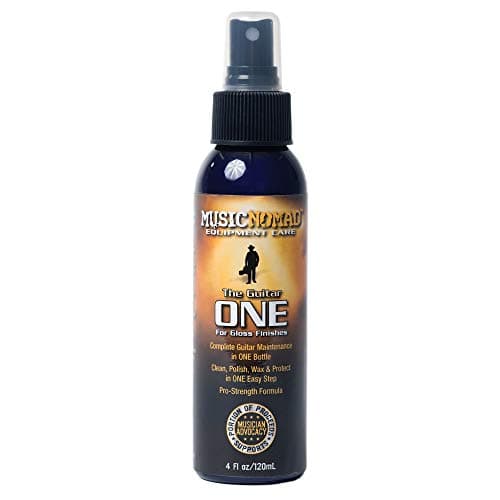
There is exactly one question worth asking about guitar polish, and almost nobody answers it on the bottle: which finishes is this safe on, and which will it ruin?
It matters because the failure is permanent. Polish is mildly abrasive and it contains wax. On a gloss finish that is the point — it lifts haze and leaves a protective layer. On a satin or matte finish it does something else: it polishes the deliberately roughened surface smooth in patches, and the guitar ends up shiny where you rubbed and dull where you did not. There is no undoing that at home.
So this page ranks on published guidance first and price second. The method — what to wipe, in what order, with what — is in how to clean a guitar.
Work out what finish you have first
Two minutes, and it decides whether you should buy anything at all.
Gloss reflects a light source as a sharp, mirror-like highlight. You can see the outline of a window in it. Most affordable guitars are gloss polyurethane.
Satin or matte scatters the reflection into a soft glow with no sharp edge. Very common on necks — a great many guitars have a gloss body and a satin neck, which means the right answer is different for two parts of the same instrument.
Nitrocellulose is a thin, soft gloss lacquer found on higher-end and vintage-style guitars. It is gloss, so polish applies — but it is chemically softer than polyurethane, which is why it gets named separately in the one piece of guidance that exists here.
1 of 4
Products here whose maker states which finishes it is NOT for
MusicNomad publishes that Guitar ONE is safe on all gloss finishes including nitrocellulose and explicitly not recommended for satin or matte. The rest publish no exclusion at all.
The criteria, in the order they decide it
1. Published finish guidance
This decides the page. A polish that names the finishes it suits is making a checkable statement; a polish that says "for guitars" is not. The difference costs about the price of a coffee and protects an instrument worth several hundred times that.
2. Whether you need a polish at all
Honestly, most beginners do not. A dry microfiber cloth after every session removes the sweat and skin oil that do the actual damage, and it is safe on every finish ever applied to a guitar. Polish is for lifting haze and fingerprints off a gloss body a few times a year, not for weekly use.
Anyone telling you a guitar needs polishing monthly is selling polish.
3. Bottle or kit
A polish on its own is cheaper and does one job. A kit adds a fretboard product and a cloth, which is genuinely useful because the fretboard needs a completely different product from the body — an unfinished rosewood board wants oil, and polish must never go near it. The formulation argument is in fretboard oil.
4. What it costs per use, which is almost nothing
A four-ounce bottle used correctly — a few times a year, a small amount on a cloth rather than sprayed at the guitar — lasts years. Price is close to irrelevant in this category, which is another reason to buy the one with the guidance rather than the one that is a dollar cheaper.
The picks
MusicNomad Guitar ONE (MN103) — only published finish guidance
MusicNomad states that Guitar ONE is safe on all gloss finishes including nitrocellulose, and explicitly not recommended for satin or matte. That single sentence is more finish guidance than the rest of this category offers combined, and it is the entire reason it wins.
It is also a cleaner, polish and wax in one step, which for a few uses a year is the right amount of process. Four ounces will outlast your interest in polishing.
Against it: it is the wrong product for a satin or matte finish and the maker says so, which rules it out for a lot of modern necks. It costs more per ounce than the Dunlop. And a wax layer is not something a first-year guitar needs — the honest use case here is three or four times a year.
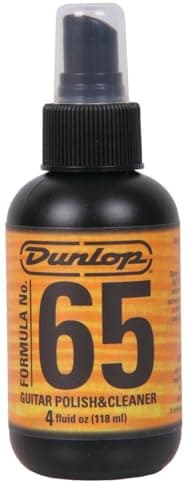
Dunlop Formula 65 Polish & Cleaner — cheapest guitar-specific polish
The bottle in every music shop for decades, at the lowest price here, and it does clean a gloss guitar perfectly well. If your guitar is plainly gloss polyurethane and you want the cheapest honest option, this is it.
It is also the same product that ships inside the System 65 kit, so buying the bottle alone is the cheaper route to the identical polish.
Against it, and it is the reason it is second: Dunlop publishes no satin or matte exclusion on the listing we checked, and nothing that tells you whether it is safe on nitrocellulose. On a category where the failure mode is permanent, an absent statement is a real cost. A combined cleaner-and-polish also gives you less control than doing the two steps separately.
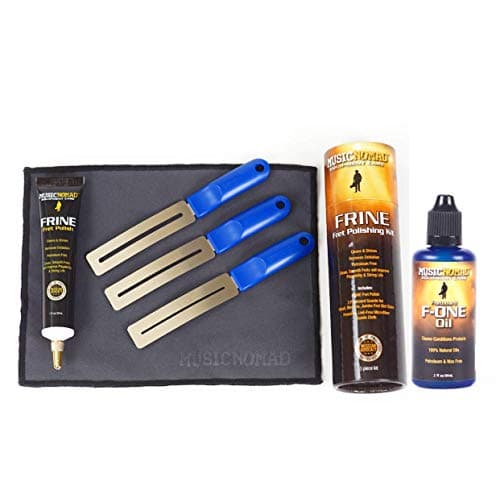
MusicNomad Premium Guitar Care Kit — best as a kit
The same Guitar ONE polish, plus F-ONE fretboard oil and a suede microfiber cloth. For someone starting from nothing this is the sensible purchase, because it covers the body and the fretboard with the correct product for each and includes the cloth that does most of the real work.
MusicNomad also publishes what the F-ONE oil does not contain — no lemon oil, petroleum, wax or water — which is unusual and useful.
Against it: you are buying a fretboard product you may not need for a year, the same satin and matte exclusion applies to the polish inside, and the 0.5 oz oil bottle is small enough that a regular user will replace it before the polish runs out.
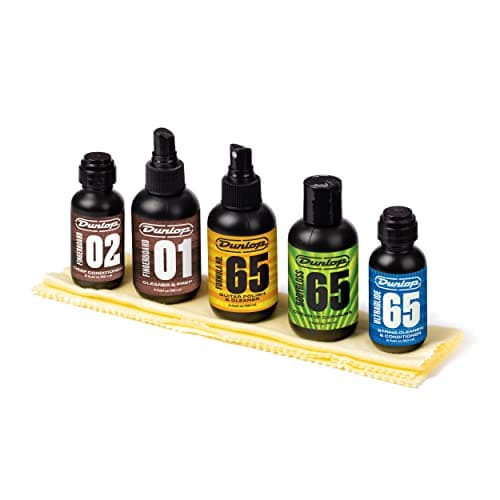
Dunlop System 65 Maintenance Kit — most in the box
The largest kit here: the Formula 65 polish plus a lemon-oil fretboard conditioner and cloths. It is the cheapest way to get several products at once and it is stocked everywhere.
Against it: the same missing finish guidance as the bottle, and a lemon-oil fretboard conditioner is the specific product some players deliberately avoid — it is a real disagreement in guitar care rather than a manufactured one, and the fretboard oil page lays out both sides. Buying a kit to get a conditioner you may not want is a poor trade.
Side by side
What each maker publishes| Product | States safe on | States NOT for | Fretboard product | Size |
|---|
| MusicNomad Guitar ONE | All gloss incl. nitrocellulose | Satin, matte | No | 4 oz |
| Dunlop Formula 65 polish | Not published | Not published | No | 4 oz |
| MusicNomad Care Kit (3 pc) | All gloss incl. nitrocellulose | Satin, matte | F-ONE oil | 2 oz + 0.5 oz |
| Dunlop System 65 kit | Not published | Not published | Lemon oil | Multiple |
Two rows say "not published" twice. In a category whose failure mode cannot be reversed, that is the finding.
How to use it without doing damage
Onto the cloth, never onto the guitar. Spraying at the instrument puts liquid into the bridge, the pickup cavities and the soundhole.
Body only. Keep it off an unfinished fretboard entirely, and off the strings — polish on strings kills them.
Not on a satin neck. Even if the body is gloss. A great many guitars are both, and the back of the neck is exactly where a patchy shine shows.
If you do not know the finish, use a dry cloth. It is safe on everything, it removes what actually harms a guitar, and it costs nothing.
What we would actually buy
If the guitar is gloss: the MusicNomad bottle, and use it three times a year. If you are equipping from scratch and the fretboard is unfinished rosewood: the three-piece kit, which covers both jobs with the right product for each. If the guitar is satin or matte anywhere you would be rubbing: buy nothing, and keep a microfiber cloth in the case.
What we did not doWe have not played any of this gear. Every guide in this category says it tested twenty tuners; we would rather say plainly that we tested none. What we did instead is on this page in full: published specifications with their sources, the makers' own manuals read rather than paraphrased, and a note wherever a company publishes nothing at all.