Start with the part that decides the outcome, because no case on this page is as important as it: if the guitar can travel in the cabin, it should. Almost every instrument damaged in air travel was checked into a hold, where it was stacked under luggage, moved by machine, and exposed to temperature and pressure changes nobody controls.
Policies on carrying an instrument into the cabin vary by airline, by aircraft and sometimes by the individual at the gate, so the only reliable move is to read your specific airline's current instrument policy before you book and to arrive early enough to board before the overhead bins fill. We are not going to summarize airline rules here, because they change and a stale summary is worse than none.
If it must go in the hold, this page is about the case that gives it the best odds — and about the four packing steps that matter more than which case you bought.
The criteria, in the order they decide it
1. A rigid shell, not padding
A gig bag protects against scuffs and weather. A hold protects against neither of those and instead applies crushing loads from above and impacts from being dropped. That is a shell problem. Gig bag vs hard case works through the general decision; for a hold there is no decision.
2. Fit, which is the mechanism rather than a comfort
A hard case works by holding the instrument still inside a rigid shell. A guitar that can move inside its case is protected from the outside world and then thrown at the inside of its own container. Fit is not a nicety in a hold — it is the entire function.
Electric cases are cut for specific body outlines, which makes this checkable if the maker publishes internal dimensions. Several do not. Measure your guitar's total length, lower-bout width and body depth, and compare.
3. Weight, because airlines charge for it
A loaded hard case is a heavy object and the case itself is a meaningful share of it. The three here run from 3.81 kg to 4.08 kg empty. That is before the guitar, and on an airline with a strict checked allowance it is real money.
4. Whether the latches lock, and what a lock is for
A case lock does two things in a hold and only two: it stops the case springing open when it is dropped, and it deters the opportunist. It will not defeat anybody determined. In the United States, be aware that a locked case may be opened by security, so a lock they cannot open is a lock they may cut.
2 of 3
Cases here that publish a full internal cavity measurement
The Gator ABS case publishes body length, width and depth plus total length. The GW publishes only the outside of the case, which tells you nothing about whether your guitar goes in.
The picks
Gator GC-Electric-A ABS — best published fit
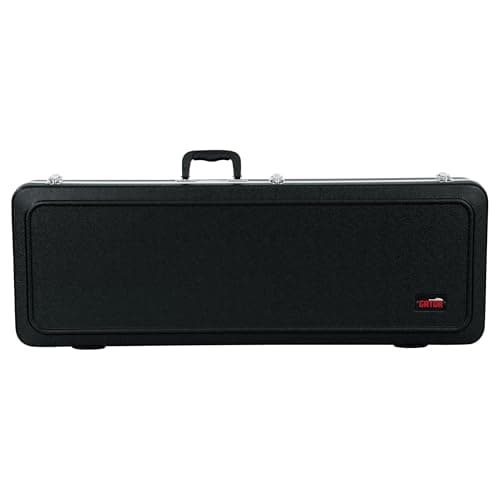
Molded ABS with EPS foam under a plush lining and a neck support, and the only case here that publishes the full internal cavity — body length, width, depth and total length. For a flight, where fit is the mechanism, that specification is worth more than any padding claim.
A rigid molded shell also resists the crushing load of being stacked under other luggage better than a covered wooden case resists it.
Against it: Gator lists it for ST and T style bodies only, so it is the wrong case for a large fraction of electric guitars. At 4.08 kg it is the heaviest here. And a rigid shell transmits more of a single hard impact through to the instrument than a padded wooden case absorbs — which is the genuine counter-argument to ABS in a hold.
Gator GW-DREAD — best for a dreadnought
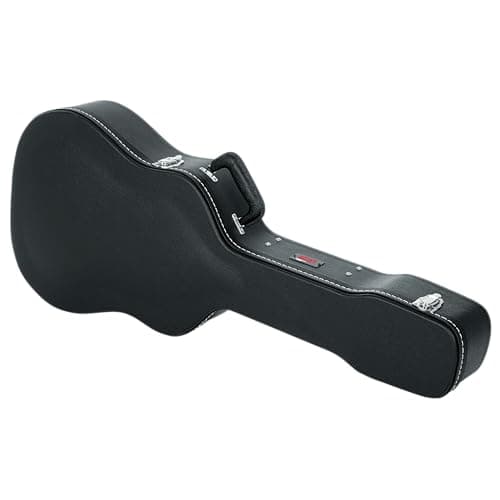
The acoustic answer. Plywood with a plush lining, sized for a dreadnought body, with the model code printed in the listing so you can confirm you are buying the right shape.
Plywood matters more for an acoustic than for a solid-body, because a wooden case crushes progressively and absorbs energy rather than transmitting it into a hollow, braced top.
Against it: it is dreadnought-shaped, so a concert or parlor body will move inside it. It is the bulkiest object here. And an acoustic in a hold faces a problem no case solves, covered below.
Gator GW-ELECTRIC — lightest hard case here
Plywood under artificial leather with a key lock and an accessory box, at 3.81 kg — the lightest of the three, which on a checked-baggage allowance is the difference that shows up at the desk.
Plywood construction is what road cases have always been made of, and the reason is that it fails gracefully: a dropped wooden case dents and keeps working.
Against it: Gator publishes only external dimensions for this one, so on a shape-specific case the fit question has no published answer — which is why it is third rather than first for a flight. The artificial leather covering scuffs where ABS shrugs.
Side by side
What Gator publishes| Case | Shell | Internal dimensions | Weight | Fits |
|---|
| GC-Electric-A | Molded ABS | Published in full | 4.08 kg | ST and T style |
| GW-DREAD | Plywood, plush lined | Not published | Not published | Dreadnought acoustic |
| GW-ELECTRIC | Plywood, artificial leather | Not published | 3.81 kg | ST and T style |
The four packing steps that matter more than the case
1. Slacken the strings a little — do not remove them. A hold is cold and the pressure changes, and a neck under full tension in those conditions has less margin. Taking them off entirely removes the tension the neck is built to sit under, which is its own problem. A tone or two down on each string is the usual advice and it is sensible.
2. Pack the headstock so it cannot move. The headstock is the most commonly broken part of a guitar in transit, because it is a long lever on a narrow neck. Fill the space around it in the case with soft clothing until it cannot shift.
3. Fill every void in the body cavity. Same principle. Anything that can move will.
4. Take the humidity problem seriously on an acoustic. A hold and a hotel room are both drier than most homes, and a solid-wood acoustic notices. A sealed case is the right environment for a two-way humidity pack to work in — see humidifiers, and measure your own situation first with a hygrometer.
The honest alternatives to flying with it
Rent or borrow at the destination. For a short trip this is frequently cheaper than the baggage fee, and it carries no risk at all.
Take a travel-size instrument. Smaller-bodied guitars fit overhead bins far more often, which converts the whole problem into a non-problem.
Ship it. A courier will treat a boxed case more gently than a baggage system will, and it can be insured for the actual value of the instrument, which checked baggage generally cannot.
None of those are products we sell and all three are better answers than a better case, which is why they are on this page.
What we would actually buy
If the guitar is a Strat or Tele shape and it is going in a hold: the ABS case, because the published cavity lets you confirm the fit before you travel and fit is the mechanism. If it is a dreadnought: the GW-DREAD, plus a two-way humidity pack. If it is any other shape, measure first and check the published internal dimensions before ordering — the electric hard case roundup has the wider comparison.
What we did not doWe have not played any of this gear. Every guide in this category says it tested twenty tuners; we would rather say plainly that we tested none. What we did instead is on this page in full: published specifications with their sources, the makers' own manuals read rather than paraphrased, and a note wherever a company publishes nothing at all.